
Direct from our manufacturing facility: high-density continuous PUR/PIR sandwich enclosures, anti-frost heavy-duty cold storage doors, and integrated condensing machinery designed to meet demanding HACCP, CE, and ISO compliance standards.
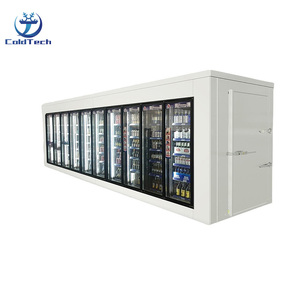
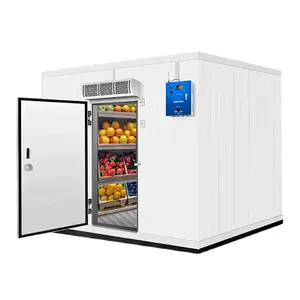
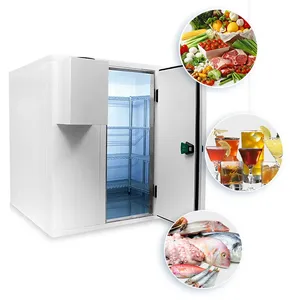
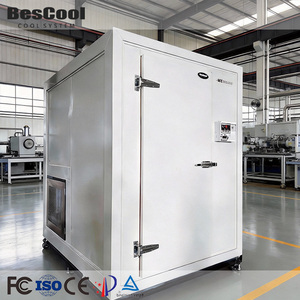
As a specialized manufacturer with high-capacity continuous polyurethane foaming lines and precision roll-forming plants, we deliver fully customized, certified walk-in cooler and freezer envelopes directly to international EPC contractors, food processors, and cold chain distributors.
Every commercial walk-in freezer is engineered to project shop drawings. We manufacture custom room heights up to 12 meters, panel thicknesses from 50 mm to 200 mm, and incorporate customized floor cuts, ceiling suspension structural brackets, and partition wall interfaces for dual-temperature preservation zones.
Using high-pressure cyclopentane injection technology, our insulation cores reach a uniform density of 42 to 45 kg/m³. Panels meet international fire safety benchmarks, including EN 13501-1 Class B-s1,d0 and ASTM E84, guaranteeing lower smoke density and zero toxic droplets during combustion scenarios.
Our panels integrate precision-engineered eccentric cam-lock hooks and dual tongue-and-groove joint profiles. When locked with an Allen key on-site, the tongue-and-groove joint compresses a seamless food-grade PVC/EPDM airtight gasket, preventing moisture vapor migration and ice buildup.
Engineered specifically to operate continuously in ambient external heat exceeding +48°C and high coastal humidity. Outer sheet options include 25-micron PVDF coatings, anti-microbial food-safe Plastisol, and medical-grade SUS304 stainless steel capable of withstanding corrosive saline environments.
We supply fully itemized calculation packages, Finite Element Analysis (FEA) thermal bridge simulations, third-party laboratory tensile/compressive test reports, and factory material certificates required by consultant engineering bodies and civil defense authorities worldwide.
Beyond insulated envelope walls and ceilings, we deliver matched Copeland scroll, Bitzer semi-hermetic, or Danfoss condensing systems complete with electronic expansion valves, intelligent defrost control panels, anti-vacuum balance valves, and emergency egress safety release systems.
Selecting correct panel thickness and density directly impacts annual operating power draw, compressor cycling duty cycles, and product shelf life. Reference our thermodynamic calculation benchmarks below:
| Panel Thickness | Core Density | Thermal U-Value (W/m²·K) | Operating Temp Range | Typical B2B Applications | Skin Coating Options |
|---|---|---|---|---|---|
| 75 mm | 42 kg/m³ PUR/PIR | 0.28 W/m²·K | +2°C to +12°C | Beverage chillers, agricultural pre-cooling, floristry | Color Steel / PE |
| 100 mm | 42–44 kg/m³ PIR | 0.21 W/m²·K | -5°C to -18°C | Standard commercial meat/poultry, dairy holding, bakery | PVDF / Plastisol |
| 120 mm | 42–45 kg/m³ PIR | 0.17 W/m²·K | -18°C to -25°C | Frozen seafood logistics, cold distribution hubs, ice cream | SUS304 / PVDF |
| 150 mm | 44–46 kg/m³ High PIR | 0.14 W/m²·K | -25°C to -35°C | Deep freezer warehouses, plasma/medical storage, blast chilling | Food-Grade Stainless |
| 200 mm | 45–48 kg/m³ Fire PIR | 0.10 W/m²·K | -35°C to -45°C | Industrial rapid blast freezers, cryogenic cold chain, tuna preservation | SUS316 / Heavy Gauge |
*Note: Thermal conductivity measured at a mean temperature of 10°C in accordance with ISO 8301. Exact U-values vary based on internal/external skin gauge (0.45mm – 0.8mm available) and thermal break profile detailing.
The commercial refrigeration landscape is transitioning through rapid environmental legislative overhauls, digital sensor deployments, and volatile energy utility tariffs. Forward-looking procurement directors prioritize the following four strategic developments:
With the global phasedown of high-GWP HFCs (such as R404A and R507) mandated by the Kigali Amendment and European F-Gas regulations, OEM walk-in freezer buyers are specifying evaporator coils and expansion valves rated for ultra-low GWP synthetic blends (R448A/R449A) as well as natural refrigerants including transcritical CO2 (R744) and Propane (R290).
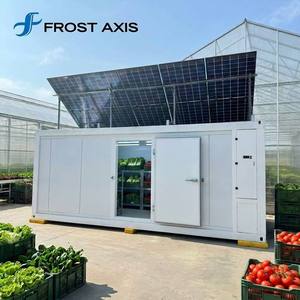
Agricultural processing centers in remote harvesting areas are aggressively investing in solar-coupled walk-in freezers. Featuring DC brushless variable-frequency compressor sets, our solar cold room enclosures store thermal energy in PCM (Phase Change Materials) or lithium battery arrays, maintaining stable sub-zero environments independent of unreliable regional power grids.
Procurement contracts now universally demand cloud-connected microcontrollers. Modbus-integrated walk-in telemetry streams real-time compartment temperature, evaporator superheat, door opening frequencies, and defrost cycle health to central operations centers, providing predictive failure alerts and automated digital HACCP compliance records.
On-site construction labor costs have driven procurement toward prefabricated walk-in kit assemblies. Factory pre-notched cam-lock panels, pre-wired frame heaters, and plug-and-play monoblock refrigeration packages allow a 100 m³ walk-in freezer to be fully erected, sealed, and commissioned within 48 to 72 hours, reducing jobsite downtime by up to 65%.
As a pioneer in insulated envelope mechanics, our R&D engineering division continuously upgrades thermal insulation chemistry, joint geometry, and anti-frost mitigation technologies to push commercial cold storage performance boundaries.
By transitioning from conventional foaming catalysts to microcellular cyclopentane reaction formulations, our manufacturing line produces cell sizes 30% smaller than typical industry averages. This closed-cell structure (>95% closed cell content) provides exceptional compressive strength under heavy pallet loading and inhibits water absorption even in continuous saturated moisture environments.
Conventional cold rooms often suffer severe frost formation around structural door frames. Our walk-in assemblies utilize co-extruded heavy-duty PVC thermal break profiles combined with self-regulating PTC heating cables. This completely decouples the cold room inner chamber from the warm external envelope, eliminating condensation sweat, floor icing hazards, and bacterial breeding zones.
For sub-zero rooms operating below -18°C continuously, ground soil moisture can freeze, expand, and shatter building concrete foundations. We design custom walk-in floor insulation packages incorporating reinforced XPS or PIR under-floor slabs, ventilated PVC subfloor pipe networks, or low-voltage heating mats engineered to safeguard civil structural foundations indefinitely.
To expedite OEM/ODM quotation accuracy and guarantee an optimal thermodynamic design match, procurement teams should define the following six technical parameters when initiating engineering discussions:
Specify chamber holding temperature (e.g., -22°C), daily product intake loading (kg/24hr), and incoming product temperature. This determines whether your system requires standard static holding capacity or a rapid pull-down blast compressor configuration.
Provide peak summer dry-bulb ambient temperature, relative humidity, and installation location (indoor warehouse vs. outdoor exposed). In tropical or Middle Eastern climates, condenser sizing and UV-protective sheet finishes must be elevated accordingly.
Identify whether the walk-in will accommodate pedestrian foot traffic, manual hand pallet jacks, or heavy electric reach forklifts. Heavy traffic necessitates reinforced 1.5mm to 3.0mm aluminum diamond treadplate, stainless steel skin, or internal reinforced concrete slabs.
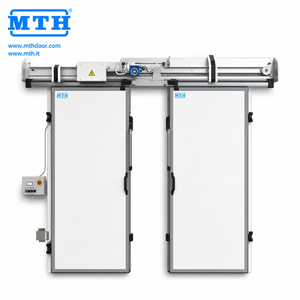
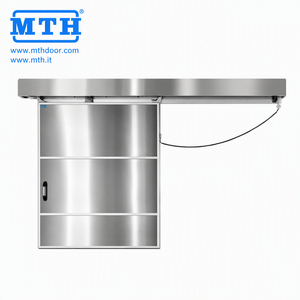
Determine opening clear widths and heights. Choose between manual hinged doors (for walk-in footprint efficiency), manual sliding doors (for space conservation), or high-speed automated motorized sliding doors equipped with radar or induction loops for busy logistics docks.
Clarify regional civil defense authority requirements. High-occupancy industrial food processing plants typically mandate FM-approved or Class B1 PIR cores to secure commercial facility operational permits and minimize building insurance underwriting premiums.
Indicate any municipal noise limits (critical for commercial retail or residential proximity) and environmental refrigerant restrictions, allowing our engineering team to provide acoustic-baffled housing and compliant compressor choices.
Authoritative, data-backed technical answers to the most common engineering and sourcing questions submitted by cold storage buyers, mechanical contractors, and consulting engineers.
For continuous -25°C holding freezers, we strongly recommend a minimum panel thickness of 120 mm to 150 mm using high-density Polyisocyanurate (PIR) core (42–45 kg/m³). PIR delivers a superior thermal conductivity rating ($\lambda \le 0.020$ W/m·K) compared to conventional EPS or standard PUR. Choosing 150 mm PIR reduces heat gain through the building envelope by more than 28%, significantly decreasing continuous compressor runtime, extending refrigeration machinery operating lifespan, and lowering annual electrical utility costs.
Cam-lock modular panels feature internal high-strength eccentric steel hooks embedded inside the high-density polyurethane core during hydraulic pressing. When installed, these locks pull adjacent panels tightly together, compressing internal EPDM airtight perimeter seals. This system offers rapid on-site assembly, easy disassembly, and future modular chamber expansion without cutting or destructively dismantling walls. Continuous tongue-and-groove panels, by contrast, are typically utilized for large-scale industrial warehouses exceeding 1,000 square meters where continuous structural girt purlins are present.
When a walk-in freezer maintains sub-zero temperatures (e.g., -18°C to -40°C) for extended durations, cold thermal energy continuously migrates downward through the insulated floor into the sub-base concrete slab and natural soil. Without thermal protection, ground moisture freezes into expanding ice lenses—a phenomenon known as frost heave. This expansion generates immense hydrostatic pressure that cracks concrete floor slabs, misaligns insulated wall panels, and destroys room airtightness. We supply low-wattage subfloor electric heating mats or PVC sub-ventilation airflow systems that permanently maintain sub-slab temperatures at +4°C.
Yes. We specialize in severe-ambient engineering tailored for high-heat regions like the Middle East, North Africa, and tropical zones. Our condensing packages incorporate oversized microchannel or hydrophilic copper-aluminum condenser coils, heavy-duty tropicalized Danfoss/Bitzer compressors, variable-speed fan motors, and high-efficiency liquid subcoolers. Additionally, our panel skins feature high-reflectivity PVDF coatings or 304 stainless steel that resist UV degradation, radiant thermal loading, and coastal salt atmospheric corrosion.
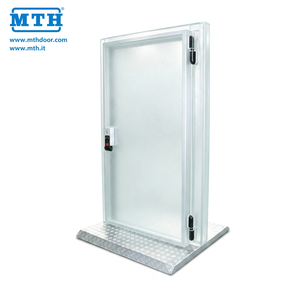
All our cold room and walk-in freezer doors comply strictly with international cold chain occupational safety codes. Standard equipment includes an internal glow-in-the-dark mechanical safety release push rod (allowing trapped personnel to unlock the door from within even if padlocked from the exterior), internal perimeter electric frame resistance heating wire to prevent door freezing, a 90° stay-open mechanism, and industrial dual-fin EPDM wipe gaskets that maintain airtight seals.
We supply a complete submittal package containing CAD layout assembly drawings, 3D structural connection schematics, panel U-value thermal heat load calculation sheets, CE conformity declarations, ISO 9001 quality certificates, and independent third-party laboratory test reports for fire performance (Class B1 / ASTM E84 flame spread & smoke developed indexes). Project-specific submittals are tailored directly to match consultant specifications.
Yes. We manufacture hybrid solar-powered walk-in cooler and freezer solutions. These systems combine high-efficiency monocrystalline solar PV arrays, MPPT charge controllers, industrial lithium-ion battery banks, and variable-frequency DC inverter scroll condensing machinery. During grid outages or in completely off-grid agricultural or maritime facilities, our systems maintain uninterrupted freezing cycles, safeguarding high-value perishable seafood, meat, and fresh agricultural produce.
Connect with our senior refrigeration application engineers. Send us your chamber dimensions, target product storage temperatures, and ambient site parameters to receive full thermodynamic calculations, layout drawings, and transparent B2B factory pricing within 24 hours.
Our sales engineers respond to project questions during working hours (GST+4).