Expertise & Technical Depth Engineering Principles of High-Performance Commercial Cold Storage Panels
Designing an energy-efficient cold facility requires precise technical evaluation of thermal expansion, joint integrity, vapor barrier continuous seals, and core density parameters.
1. Core Material Comparison: PIR vs. PUR vs. Rockwool
Choosing the correct core matrix dictates operational energy expense over a 25-year facility lifespan. Commercial refrigeration engineers evaluate thermal conductivity ($\lambda$-value), compressive strength, and reaction to fire when finalizing panel specifications:
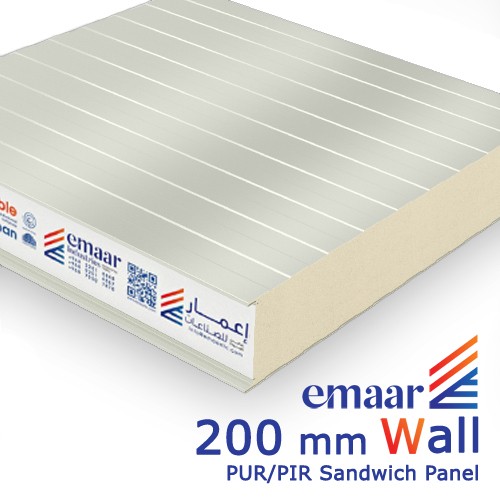
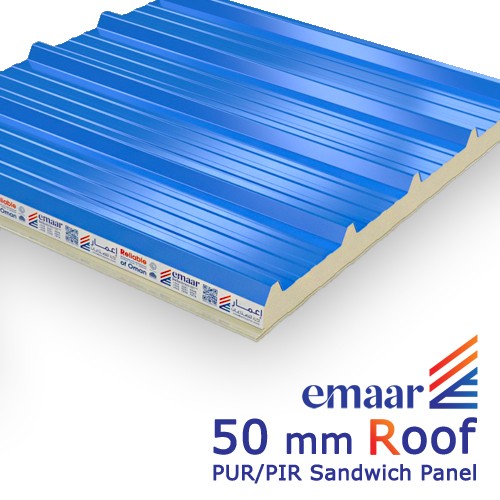
- Polyisocyanurate (PIR): Formulated with an isocyanurate ring ratio exceeding 1.8:1, PIR offers superior microcellular structure delivering thermal conductivity as low as 0.020 – 0.022 W/m·K. It forms a protective carbonaceous char when exposed to flame, securing B-s1, d0 fire classifications required by GCC Civil Defence authorities.
- Polyurethane (PUR): Delivers excellent structural stiffness and cost-effective thermal insulation ($\lambda \approx 0.024 \text{ W/m}\cdot\text{K}$) with a closed-cell ratio above 95%. Ideal for standard commercial chillers and ambient controlled environment rooms.
- Mineral Rockwool: Manufactured from spun volcanic basalt fibers (density 100-140 kg/m³). Provides an A1 non-combustible core rating ($\lambda \approx 0.038 – 0.040 \text{ W/m}\cdot\text{K}$) specifically specified for fire walls separating refrigeration plant rooms from main processing floors.
2. Thermal Bridge Mitigation & Vapor Seal Integrity
Moisture vapor penetration is the primary cause of ice buildup, core degradation, and thermal failure in commercial cold storage operations. When warm, humid outdoor air encounters sub-zero interior air, moisture moves across the wall assembly driven by vapor pressure differential.
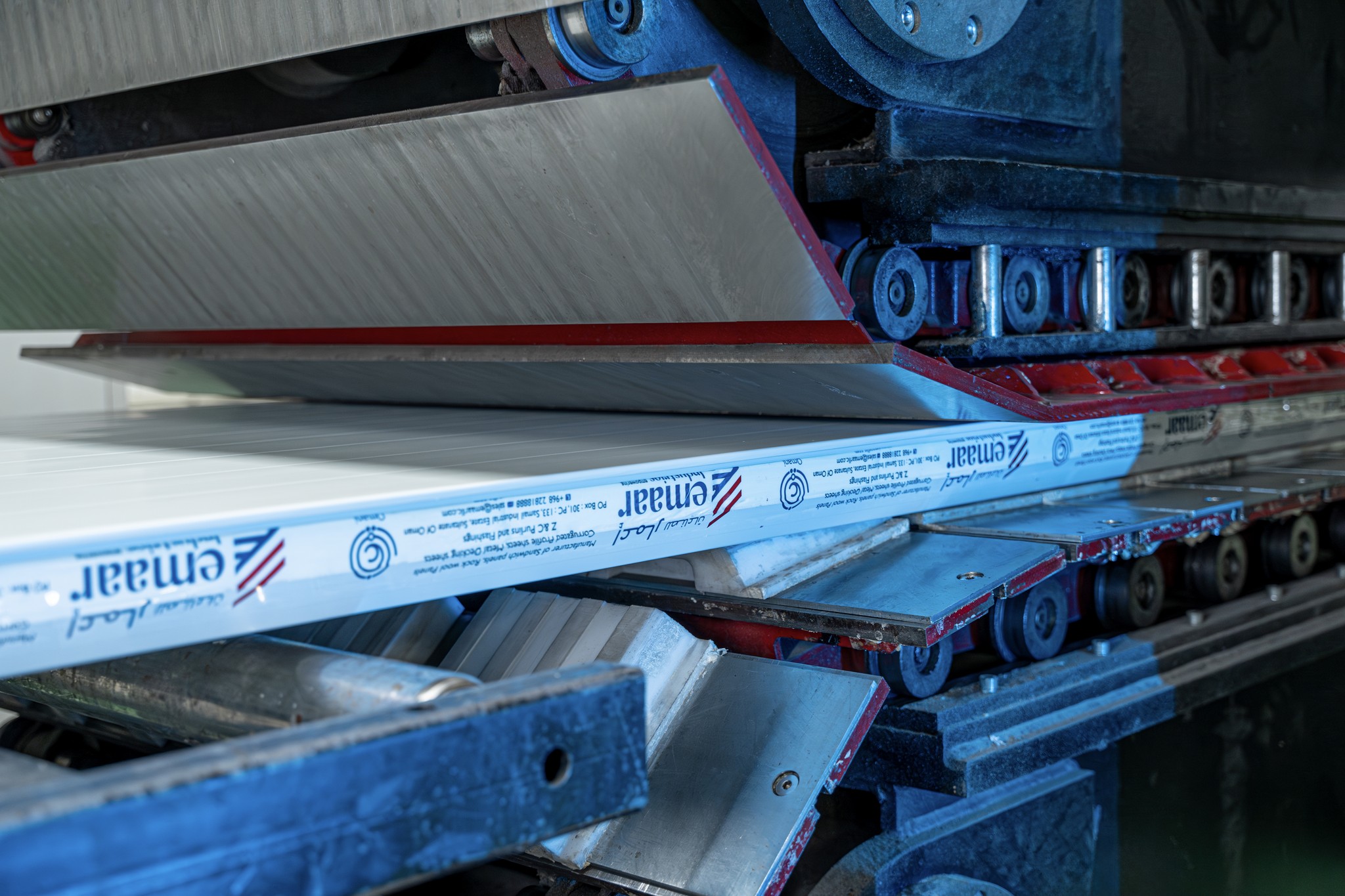
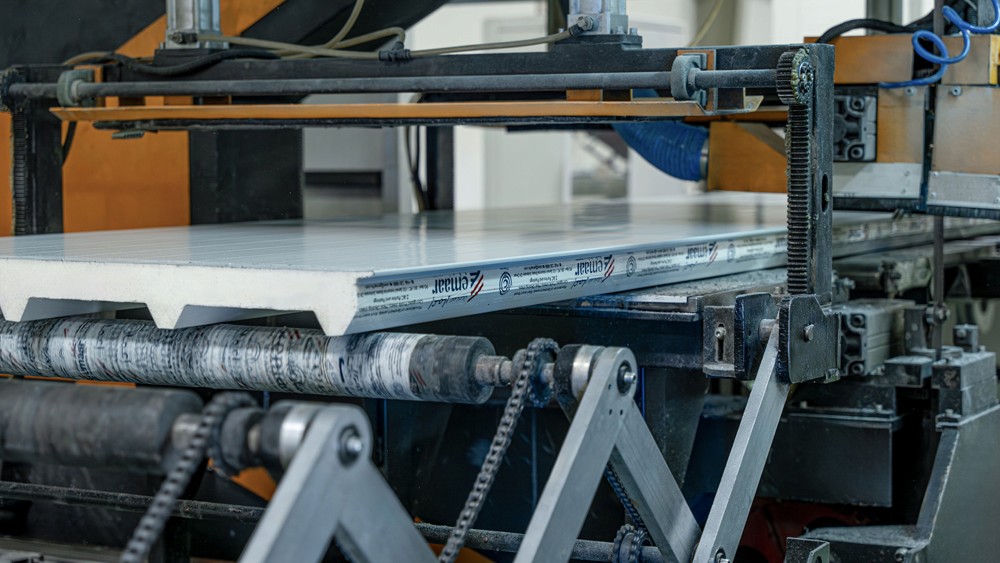
Emaar Industries solves thermal bridging through an engineered double tongue-and-groove joint profile equipped with factory-applied dry gaskets and field-injected non-curing butyl sealants. For walk-in freezers and low-temperature applications, our panels feature eccentric cam-lock hardware embedded during high-pressure polyol dispensing, achieving continuous perimeter compression that locks out thermal leaks completely.