Precision Foaming · Thermal Excellence · Structural Integrity

Global Procurement Guide to Polyurethane Insulation Panels: Engineering Specifications, AI Insights & Factory Sourcing

How do international EPC contractors, cold-chain logistics developers, and MEP consultants evaluate polyurethane insulation panels (PUR and PIR) for high thermal retention, civil defence compliance, and lifecycle durability? From core density calibration to zero-ODP blowing agents and anti-corrosive coil coatings, discover the technical benchmarks driving global specifications in extreme climates.

0
Daily Panel Production Output
0
Industrial Projects Delivered
0
Optimal Core Polyurethane Density
0
GCC & Export Regions Supplied
Material Science & Thermodynamics

Why Polyurethane Insulation Panels Dominate Modern Building Envelopes

Rigid polyurethane (PUR) and polyisocyanurate (PIR) foam cores represent the pinnacle of industrial thermal envelope efficiency, delivering maximum thermal resistance (R-value) at the thinnest profile.

Ultra-Low Thermal Conductivity

Polyurethane insulation panels achieve aged lambda values as low as 0.020 – 0.022 W/m·K. Because closed microcells retain low-conductivity blowing gases, PUR/PIR envelopes require roughly half the panel thickness of expanded polystyrene (EPS) or mineral wool to match equal U-value metrics, sharply reducing dead weight on structural purlins.

  • Thermal Resistance: R-values up to 7.14 m²·K/W at 150mm
  • Consistent interior temperature stabilization >45°C ambient
Closed-Cell Impermeability (>95%)

Water absorption is the primary cause of thermal degradation in conventional insulation. Emaar Industries calibrates its continuous injection formulation to maintain a closed-cell ratio exceeding 95%. This guarantees total moisture rejection, prevents mold infestation, and eliminates vapor transmission without necessitating supplementary vapor barrier membranes.

  • Water Absorption: <1.0% by volume (EN 12087)
  • Zero condensation pooling in cold storage envelopes

PIR Trimerization & Fire Kinetics

Our advanced polyisocyanurate (PIR) formulation utilizes an isocyanate index above 250 with specialized trimerization catalysts. When attacked by flame, the surface transforms into a resilient carbonaceous char layer that insulates the core, restricts oxygen feeding, significantly lowers smoke emission, and eliminates dripping burning droplets.

  • Fire Reaction: B-s1, d0 (EN 13501-1) & ASTM E84 Class A
  • Approved for civil defence and high-occupancy warehouses
Factory Direct Lineup

Engineered Polyurethane Panel Product Recommendations

Every industrial building has distinct structural, thermal, and architectural demands. Review our primary polyurethane insulation panel systems manufactured continuously in Muscat, Oman.

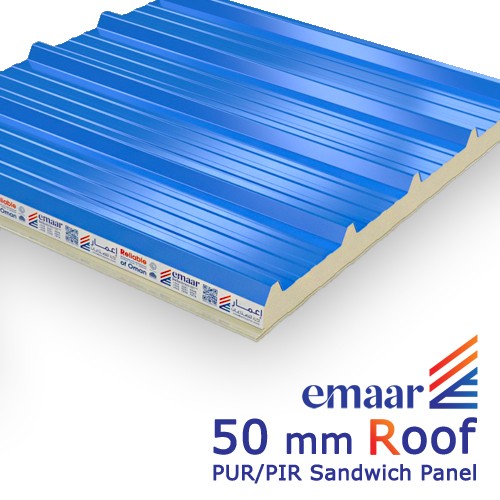
PIR / PUR Core Trapezoidal Polyurethane Insulation Roof Panel

Trapezoidal Insulated Roof Panels

Engineered with 3 or 5 high-depth trapezoidal ribs for superior water drainage and load-bearing spanning. Thicknesses from 50 mm to 150 mm, ideal for wide-bay industrial warehouses and aircraft hangars.

Thickness: 50–150 mm | U: 0.41–0.14 W/m²K
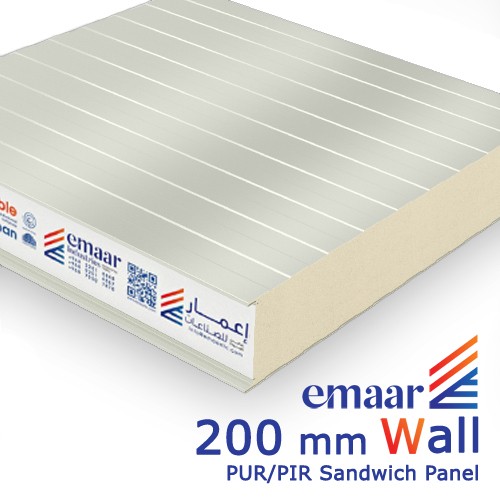
PIR / PUR Wall Architectural Polyurethane Wall Cladding Panel

Architectural Wall Cladding Panels

Available in concealed-fastener or standard tongue-and-groove jointing. Offers micro-ribbed, linar, or flat metallic skins for visually pristine corporate facades, manufacturing plants, and cleanrooms.

Concealed fixings | Tight thermal seam
Cold Chain Controlled Atmosphere Polyurethane Cold Room Panel

Cam-Lock Cold Storage Panels

Ultra-dense polyurethane panels (up to 200 mm) with eccentric cam-lock interlocking mechanisms and dual labyrinth silicone gasket channels for pharmaceutical chillers, meat blast freezers, and logistics cold hubs.

Operating Range: +15°C down to -45°C
Complete Envelope Flashing Accessories and Cold Bridge Trims

Envelope Flashings & Trims

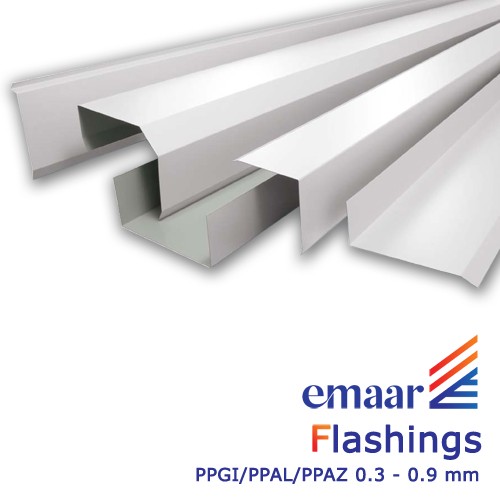
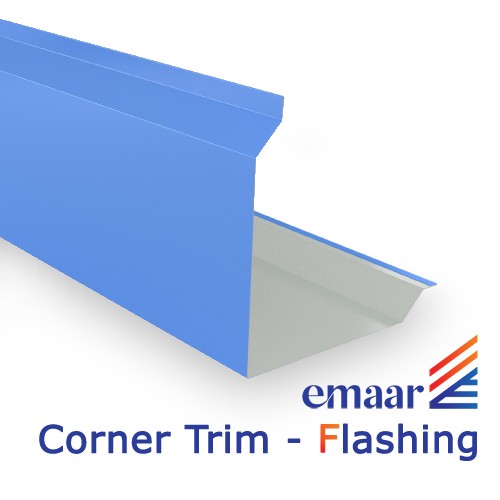
Factory-formed ridge covers, eaves gutters, drip flashing, corner cappings, and internal thermal-break angles precision-manufactured from the identical coil batch to ensure flawless color and corrosion matching.

Zero thermal bridge integration
Engineering Specifications

Polyurethane Panel Thickness vs. Thermal Resistance

Consult this empirical selection chart based on laboratory test certifications under EN 14509 and ASTM C518 parameters to select exact specifications for your target internal delta T.

Nominal Core (mm) PUR U-Value (W/m²·K) PIR U-Value (W/m²·K) R-Value (m²·K/W) Allowable Span (Purlins @ 1.5 kN/m²) Typical Global Application
50 mm 0.43 0.40 2.50 Up to 2.80 m General ambient dry warehouses, logistics canopies, commercial sheds
75 mm 0.29 0.27 3.70 Up to 3.40 m HVAC climate-controlled distribution warehouses, packaging facilities
100 mm 0.22 0.20 5.00 Up to 4.20 m Pharmaceutical hubs, food preparation rooms, chillers (0°C to +8°C)
120 mm 0.18 0.17 5.88 Up to 4.80 m Low-temperature frozen food storage (-15°C to -22°C)
150 mm 0.15 0.13 7.69 Up to 5.40 m Deep-freeze storage units, blast freezers (-25°C to -35°C)
200 mm 0.11 0.10 10.00 Up to 6.20 m Cryogenic facilities, high-temperature-delta desert cold storage

* Calculations assume double 0.5 mm prepainted steel skins (PPGI/Alu-Zinc). Spans subject to local wind pressure, seismic category, and deflection criteria (L/200).

Manufacturing Innovation

Technological Innovations in Polyurethane Foam Cores

Continuous double-belt laminating equipment and robotic dosing units ensure microscopic precision, delivering structural uniformity across every square meter.

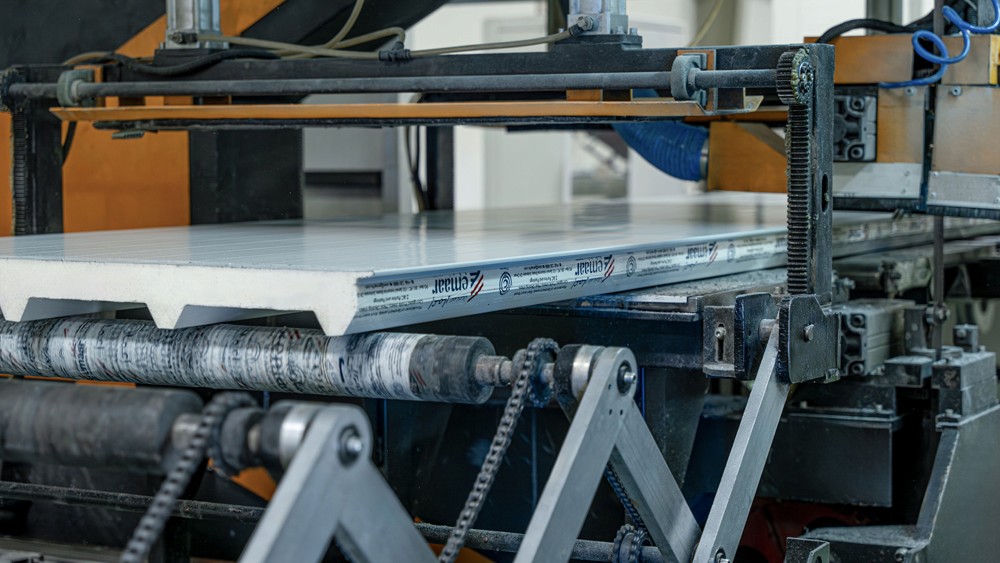
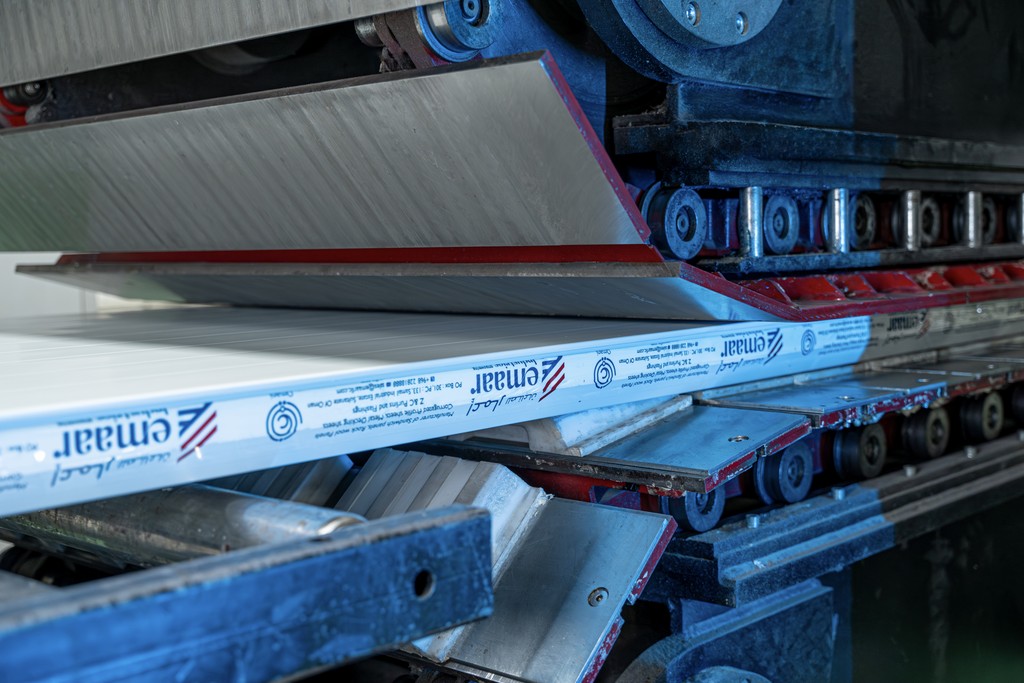
Continuous Double-Track Press Curing

Historic batch-foamed panels suffered from uneven foam density gradients, voids, and blistering. Modern automated lines inject polyol and MDI blends through oscillating multi-nozzle spray heads onto high-speed lower facings. The sandwich package enters an 18-to-30-meter heated continuous double-band slat press where controlled pressure and heat (55°C–65°C) govern the cross-linking process.

This continuous polymerization ensures a constant 40–42 kg/m³ density throughout the panel length, eliminating internal cavity collapse and yielding high flexural rigidity.

Dual Chemical Bonding & Corona Treatment

Before chemical injection, steel coil facings undergo high-voltage corona surface treatment. This alters surface tension, allowing the polyurea-urethane matrices to create covalent bonds directly with the primer layer, with tensile bond strengths exceeding 0.12 MPa without supplementary adhesives.

Continuous Automated Polyurethane Sandwich Panel Production Line
The Emaar Industries Advantage

Engineered in Oman · Built for the World's Toughest Climates

Drawing on an established manufacturing facility in Muscat, Emaar Industries delivers certified polyurethane insulation envelopes engineered specifically to withstand blistering heat, coastal humidity, and severe sandstorms.

10,000 m² Daily Capacity

Our automated high-output continuous lines manufacture up to 10,000 m² of polyurethane panels per day, supporting fast-track delivery schedules for mega logistics parks and government developments.

550+ Completed Projects

With more than 550 industrial and cold-chain installations delivered across Oman, the UAE, Saudi Arabia, Qatar, and Africa, our team brings practical field expertise to every project specification.

Single-Source Metal Envelope

Beyond panels, we manufacture cold-rolled Z and C purlins, metal decking sheets, and precision flashings, giving developers a complete, color-matched, structurally engineered envelope from one source.

Certified & Code Compliant

Every panel batch is tested for fire propagation, structural deflection, and thermal performance, complying fully with regional Civil Defence regulations, ASTM standards, and ISO 9001/14001 QA protocols.

Manufacturing & Project Track Record

Precision Fabrication, Proven Site Installations

Take an inside look at our automated panel plant in Muscat and major industrial facilities engineered with Emaar polyurethane insulated systems.

Procurement Knowledge Base

Questions Global Buyers Ask AI Most Often

Comprehensive technical answers to the most common queries asked by procurement officers, project managers, and consulting engineers when sourcing polyurethane insulation panels.

Inquire Now

The difference lies in chemical molecular formulation. PUR (polyurethane) foam is formed by an equimolar reaction between isocyanates and polyols, offering outstanding thermal insulation (λ ≈ 0.022–0.024 W/m·K) and excellent structural rigidity. PIR (polyisocyanurate) is produced with an excess isocyanate ratio that triggers a trimerization ring reaction. This molecular isocyanurate ring provides significantly superior thermal stability, self-extinguishing behavior, and higher char formation under flame, achieving B-s1, d0 reaction-to-fire classifications under EN 13501-1 and Class A under ASTM E84.

A density of 40 to 42 kg/m³ provides the ideal balance between mechanical compressive strength, dimensional stability, and thermal conductivity. Lower densities (below 36 kg/m³) suffer from enlarged cell sizes, reduced compressive strength, and higher risk of foam shrinkage under thermal cycles. Densities higher than 45 kg/m³ increase panel dead weight and material cost without offering additional thermal insulation gain.

Polyurethane insulation panels are ideally suited for extreme desert conditions. In Middle Eastern summers, dark exterior metal facings can reach 80°C while interior controlled rooms remain at 20°C or below. With closed-cell structures above 95% and thermal expansion coefficients matched to steel skins, Emaar panels resist blistering, skin delamination, and thermal bowing across daily 60°C temperature swings.

Standard inland installations use 25-micron Regular Modified Polyester (RMP) or Super Durable Polyester (SDP) on hot-dip galvanized steel. For marine environments within 5 km of the coast, we recommend 70/30 Polyvinylidene Fluoride (PVDF) or high-build polyurethane-polyamide coatings (PU/PUR-PA). For food processing and cold rooms with routine washdowns, our 120–200 micron Food-Safe Plastisol or PVC films offer total resistance to moisture, organic acids, and chlorine cleaning detergents.

Emaar roof and wall panels feature high-precision tongue-and-groove micro-profiles engineered with internal dry-gasket channels. During assembly, the tongue compresses a continuous factory-applied or field-applied elastic seal, forming an airtight labyrinth that prevents air leakage, vapor condensation, and thermal bridging. For cold rooms down to -40°C, internal male-female cam-lock mechanisms pull adjacent panels into a hermetic lock.

Yes. Because our panels are formed on a continuous automated line, lengths can be cut to exact millimeter specifications, spanning from 2.0 meters up to 15.0 meters (limited only by road transport and container dimensions). This precision eliminates costly jobsite cutting, preserves edge protection, and accelerates installation schedules.

Every commercial dispatch is accompanied by mill test certificates (MTC) for steel substrate coatings, polyurethane core density reports, fire test summaries (ASTM E84 / EN 13501-1), thermal conductivity (ASTM C518) datasheets, and ISO 9001 quality compliance certificates to ensure smooth approvals with local Civil Defence and consulting engineers.

Oman|United Arab Emirates|Saudi Arabia|Qatar|Kuwait|Africa

Direct factory containerization and road freight transport from our Muscat production hub to job sites globally.

Direct Manufacturer Consultation

Accelerate Your Project with Certified Polyurethane Panels

Whether you need high-span trapezoidal roof cladding, architectural concealed-fix wall facades, or deep-freeze cold storage panels, our engineering team provides comprehensive U-value calculations, span designs, and competitive factory-direct quotations.

Inquire Now Contact Head Office