
Exclusively manufactured under certified international quality regimes (CE, NSF, ETL, ISO 9001). Each thermal barrier assembly is calibrated to resist Jakarta's year-round 85% relative humidity and severe maritime saline corrosion.
Operating temperature-controlled facilities across the Special Capital Region of Jakarta (Daerah Khusus Ibukota Jakarta) and the greater Jabodetabek industrial belt presents some of the most aggressive environmental challenges in global thermodynamics. With ambient afternoon temperatures routinely surging between 32°C and 36°C coupled with sustained relative humidity (RH) fluctuating between 75% and 92%, the atmospheric vapor pressure exterior to a cold room facility can exceed 4.8 kPa. Inside a standard frozen food storage warehouse or blast freezer operating between -18°C and -35°C, vapor pressure drops to a negligible 0.12 kPa.
This immense vapor pressure gradient (ΔP > 4.6 kPa) exerts continuous inward hydrostatic force across every joint, gasket seal, and threshold interface. Conventional cold room doors designed for temperate European or North American climates experience catastrophic failure within 12 to 18 months when deployed in North Jakarta or Bekasi: door perimeter frame condensation ("sweating"), ice bridging along the frame gaskets, thermal runaway, motor burnout from high friction, and rampant microbial colonization. As China's leading cold room door systems manufacturer dedicated to the Indonesian archipelago, our engineering philosophy tackles these tropical maritime constraints through targeted mechanical innovations.
Our heavy-duty aluminum and stainless door leaf frames incorporate co-extruded dual-chamber rigid PVC thermal breaks. By physically decoupling the outer metal skin (+34°C ambient) from the inner cold face (-25°C), we eliminate conductive cold bridging, keeping exterior skin temperatures permanently above the local Jakarta dew point of 27.8°C without relying excessively on energy-draining heating wires.
Unlike fixed-wattage heating wires that either overheat and waste expensive PLN industrial electricity (Tarif Tenaga Listrik Industri) or underheat and allow ice freezing on door gaskets, our systems integrate multi-core PTCR (Positive Temperature Coefficient Resistance) heating elements embedded inside both the four-sided frame profile and the heavy-duty bottom threshold drop-seal.
To eliminate friction wear and ensure complete airtight integrity, our heavy-duty sliding doors leverage precision Italian-engineered track mechanics. Upon closure, the leaf drops down 12mm and pulls inward 10mm simultaneously, compressing three-lip ethylene propylene diene monomer (EPDM) gaskets tightly against the jambs without scraping or tearing the rubber profile.
Every logistics depot, hypermarket central kitchen, and marine cold store in West Java requires a specific kinematic movement profile to balance cycle speeds, thermal envelope retention, and operational footprint.
Available in manual or fully automated electric configurations (SEW-Eurodrive / Mitsubishi inverter driven). Built with door leaf thicknesses of 100mm, 120mm, 150mm, and up to 200mm high-density Polyisocyanurate (PIR) core (42-45 kg/m³). Engineered for clear opening spans up to 4500mm x 5000mm, catering to standard counterbalanced forklifts and automated guided vehicles (AGVs) operating in high-rack Tanjung Priok logistics centers.
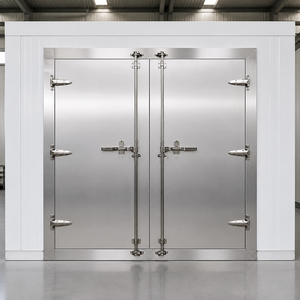
Precision-crafted with AISI 304 or marine-grade AISI 316L stainless steel leaf facings. Heavy-duty 3D adjustable composite cam-lift hinges allow the door to rise effortlessly as it swings open, eliminating dragging over unlevel epoxy or polished concrete floors. Incorporates internal luminous escape push-rods and anti-entrapment safety latches complying with European EN 179 and international OSHA norms.
Engineered for high-frequency traffic zones cycling hundreds of times per shift. Featuring an insulated double-layer PVC curtain embedded with flexible closed-cell aerogel insulation (overall thermal resistance U ≤ 1.2 W/m²·K). Velocity reaches up to 2.0 m/s with integrated radar, loop detectors, and anti-collision self-repairing zips that reset into tracks automatically following an accidental impact.
Specifically engineered for long-term fresh fruit (apples, shallots, garlic, citrus) preservation hubs in Cikarang and Cibitung. Features specialized 100% gastight perimeter inflatable or mechanical eccentric clamping seals, gas-sampling inspection inspection ports, and positive pressure locks to sustain low-oxygen (O₂ < 1%) and high-CO₂ atmospheric balances without leakage.
| System Model | Operating Temp Range | Insulation Core / Density | Surface Cladding Options | Air Permeability Rating | Typical Jakarta Facility Fit |
|---|---|---|---|---|---|
| CR-SL150 UltraGlide Industrial | 0°C down to -30°C | PIR Polyisocyanurate (45 kg/m³) | SUS304 / 0.6mm PVDF Color Steel | Class 4 (EN 12426) < 0.5 m³/h·m² | High-throughput 3PL logistics (Marunda, MM2100) |
| CRYOMAX-304 Double Swing | +15°C down to -25°C | PUR Polyurethane (42 kg/m³) | AISI 304 1.0mm Hairline Stainless | Class 3 (EN 12426) | Seafood processing (Muara Baru, Sunda Kelapa) |
| HS-FRZ200 High-Speed Spiral | -25°C down to +10°C | Multilayer Thermal Composite Aerogel | Heavy-Duty Tear-Proof PVC 1300g/m² | Class 2 (EN 12426) with Air Curtain | FMCG E-commerce fulfillment (Shopee, Tokopedia hubs) |
| CA-GT100 Gas-Tight Series | -2°C down to +8°C | Cyclopentane-foamed PIR (45 kg/m³) | Food-grade antibacterial Plastisol | Gastight ΔP 200 Pa Leakage < 0.1 cm²/m² | Horticultural produce vaults (Karawang, Cikarang) |
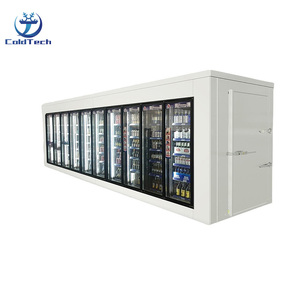
| GL-DISP300 Heated Glass Display | -20°C to +4°C | Argon-Filled Triple Tempered Glass | Anodized Aluminum with Internal LED | Condensation-Free at 85% RH Ambient | Modern Trade (Indomaret, Alfamart, Transmart DC) |
From portside fish terminals to inland pharmaceutical cleanrooms, cold storage door performance directly impacts bottom-line operating profitability and product freshness.
Jakarta’s premier tuna, shrimp, and pelagic fish processing centers require blast freezer doors capable of cycling down to -45°C. Exposure to relentless marine sea salt mist demands 100% 304 or 316-grade stainless steel tracks, nylon-coated stainless rollers, and non-corroding heated frame assemblies to stop salt encrustation and door freeze-up.
Surging e-grocery demand across Greater Jakarta has concentrated massive multi-temperature cross-docking distribution centers along the Jakarta-Cikampek toll highway. Here, high-cycle automatic sliding doors equipped with radar sensors and safety light grids cycle up to 1,200 times daily while maintaining stable internal chiller chambers.
Indonesia's BPOM (Badan Pengawas Obat dan Makanan) enforces strict Good Distribution Practice (CDOB) requirements for biologics and insulin stored between +2°C and +8°C. Our flush-mounted hinged and sliding cleanroom doors provide smooth antimicrobial surfaces that withstand aggressive bio-decontamination without particle trap joints.
To align with BPJPH Halal logistics mandates, cross-contamination prevention is paramount. Our food-grade door systems utilize USDA/NSF compliant antimicrobial silicone gaskets, seamless high-pressure foaming with zero voids, and non-porous stainless skin finishes that withstand daily high-pressure chemical washdowns without blistering.
The cold storage landscape in Indonesia is undergoing an unprecedented structural transition driven by government modernization initiatives, rapid urban consumer behavioral shifts, and major geopolitical decentralization:
1. Decentralized Logistics & The Nusantara (IKN) Spillover: While Jakarta remains the financial and transshipment heartbeat of Indonesia through Pelabuhan Tanjung Priok, national food distribution initiatives (Sistem Logistik Ikan Nasional - SLIN) are decentralizing toward outer islands and the new national capital, Nusantara (IKN) in East Kalimantan. Jakarta-based EPC contractors and cold chain operators are standardizing on modular, containerized, and rapid-erect cold room systems. By supplying precision prefabricated cam-lock cold room panels, pre-hung stainless steel doors, and integrated plug-and-play refrigeration systems from China, we empower contractors to assemble field-ready blast freezers within 72 hours of site clearance.
2. Skyrocketing Industrial Power Tariffs & Green Warehousing: With Perusahaan Listrik Negara (PLN) updating its tariff adjustments for large industrial customers (Golongan I-3 and I-4), refrigeration accounts for upwards of 65% to 75% of total warehouse operational expenditure. A leaking cold room door or degraded seal translates directly into millions of Indonesian Rupiah (IDR) wasted monthly in compressor overwork. The market is aggressively pivoting toward zero-thermal-bridge doors insulated with ozone-safe, zero-GWP Cyclopentane-blown PIR foams that reduce thermal transmission (U-value) by up to 28% compared to legacy EPS or low-density PUR panels.
3. IoT Sensor Integration & Predictive Maintenance: Modern cold chain hubs operating in Marunda Center and Kawasan Industri Jababeka are standardizing on smart building management systems (BMS). Our latest generation electric cold room doors integrate Modbus/RS485 and wireless IoT gateways, continuously broadcasting parameters including door cycle frequency, seal heating element health, air leakage velocity, and perimeter temperature data to facility management dashboards in real-time.
Full implementation of Law No. 33/2014 requires end-to-end Halal compliance. Cold room doors must offer complete traceability, sanitary non-absorbent surfaces, and certified non-porous seals preventing grease accumulation and animal byproduct cross-contamination.
As cold storage operators install rooftop photovoltaic (PV) arrays, maintaining an ultra-insulated building envelope is vital to enable off-grid solar peak-shaving during peak daylight heat spikes in coastal Jakarta.
Leveraging direct weekly container departures from Shanghai, Ningbo, and Shenzhen straight into Pelabuhan Tanjung Priok enables a remarkably agile 12-14 day ocean transit, reducing procurement cycles by weeks compared to European imports.
Decades of dedicated cold storage engineering, continuous automated continuous foaming lines, and stringent QA testing protocols guarantee that our products exceed demanding tropical performance criteria.
Equipped with state-of-the-art Italian high-pressure continuous foaming machines, our facilities maintain daily outputs exceeding 10,000 m² of PIR/PUR sandwich panels and hundreds of custom cold room door assemblies with micro-millimeter tolerance control.
As a certified Chinese exporter under the ASEAN-China Free Trade Area (ACFTA), we issue verified Form E origin documentation, entitling Indonesian importers to claim 0% or substantially preferential import duties under the Indonesian Harmonized System (HS).
All core formulations and door hardware assemblies undergo rigorous fire and safety testing compliant with CE, NSF, ETL, and ASTM E84 Class A fire-retardant standards (PIR B1 fire performance), expediting local authority approval across Indonesia.
We do not supply off-the-shelf compromises. Every order is engineered to structural drawings: opening sizes, track overhangs, threshold recesses, motorized control logic, and color steel coatings (RAL9002, RAL9006, or marine fluorocarbon finishes) matched precisely to client specs.
Clear, technically detailed answers covering logistics, customs clearance, electrical compatibility, and maintenance protocols for Indonesian cold chain projects.
Direct ocean container shipments departing from major Chinese ports (Shanghai, Ningbo, Qingdao, or Shenzhen) have an average transit time of 10 to 14 days to Pelabuhan Tanjung Priok, Jakarta. We provide a full commercial export documentation package including Bill of Lading, Commercial Invoice, Packing List, Mill Test Certificates, and the critical ACFTA Form E certificate, which allows Indonesian buyers to import qualified cold room doors and sandwich panels under 0% or reduced preferential tariff classifications.
Jakarta’s rainy season brings sustained ambient relative humidity levels above 90%, which causes surface condensation whenever a surface is cooler than the 28°C dew point. Our door systems eliminate this by combining high-density PIR thermal cores (thermal conductivity ≤ 0.019-0.022 W/m·K), multi-cavity structural PVC thermal breaks, and dual-circuit self-regulating PTCR perimeter frame heaters. These heaters dynamically modulate wattage based on local temperature, keeping frame surface temperatures safely above the ambient dew point without wasteful power drain.
Yes. All our automated electric drives, smart control microprocessors, safety sensors, and perimeter heater wires are fully customized to match the standard Indonesian utility parameters: 3-phase 380V ±10% at 50Hz for industrial heavy equipment, or single-phase 220V 50Hz for control boxes, LED light bars, and frame heaters. Control systems come standard with over-voltage and phase-reversal protection to safeguard motors against local grid fluctuations.
For installations within 15 km of the coastline (e.g., Muara Baru, Ancol, Marunda, Tanjung Priok), we recommend either full AISI 304 or marine-grade AISI 316L stainless steel door leaves, or galvanized steel skins treated with a high-build 25-micron PVDF (polyvinylidene fluoride) fluorocarbon coating rated for C4/C5 marine environments. All structural track brackets, rollers, bolts, and hinge hardware are manufactured from passivated stainless steel or heavy corrosion-resistant composite polymers to resist salt fog pitting.
Yes. We specialize in bespoke engineering. Sliding doors can be manufactured for clear openings up to 5.0 meters wide by 6.0 meters high, suitable for reach trucks, counterbalance forklifts, and overhead monorail meat carcasses. Every door is shipped with an all-inclusive hardware installation package: factory pre-aligned upper guide rails, bottom internal guide rollers, stainless steel back frames, internal luminescent safety escape push handles, and comprehensive assembly drawings.
Absolutely. All food-contact surfaces and perimeter sealing gaskets are fabricated from non-toxic, non-odor-emitting, food-grade antimicrobial EPDM or silicone that meets international USDA, FDA, and European sanitary norms. The seamless panel joints and flush door frame profiles eliminate crevices where organic residue, bacteria, or moisture can pool, guaranteeing full compliance during BPOM inspections and BPJPH Halal facility audits.
Whether you are designing a high-bay 3PL cold logistics park in Cikarang, an automated seafood processing facility in North Jakarta, or a pharmaceutical vaccine vault in Pulogadung, our senior thermal engineering team is ready to evaluate your layout drawings, deliver wind load and thermal transmission calculations, and provide competitive factory-direct CIF Jakarta quotes.
Contact UsOur sales engineers respond to project questions during working hours (GST+4).