
Manufactured on continuous multi-stand roll-forming lines with verified metallurgy, high-tolerance yield strengths, and ASTM/CSA-certified corrosion coatings.
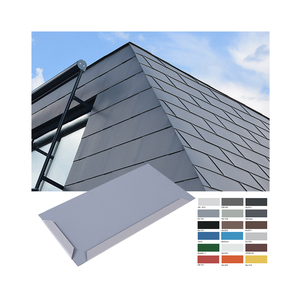
Continuous hot-dip aluminum-zinc alloy substrate coated with heavy SMP or PVDF topcoats. High resistance to edge creep and thermal expansion during extreme Southern Ontario temperature fluctuations.
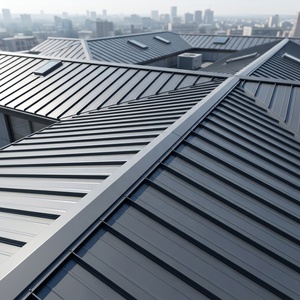
Premium double-lock standing seam profile preventing moisture entry from severe ice damming and driving rain along Toronto's lakefront and high-wind zones.
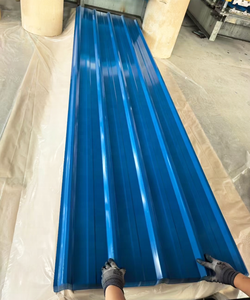
High-build structural PPGI sheets calibrated for light commercial warehouses, institutional outbuildings, and modular construction requiring certified tensile loads.
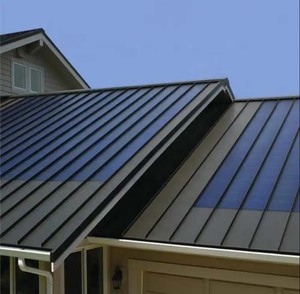
Engineered for commercial envelopes subjected to intense urban de-icing salt sprays and chemical atmospheric deposits throughout the Greater Toronto transport corridors.
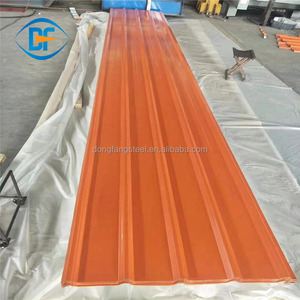
Roll-formed with precision capillary grooves preventing ponding siphonage on low-pitch logistics distribution centers in Mississauga, Vaughan, and Milton.
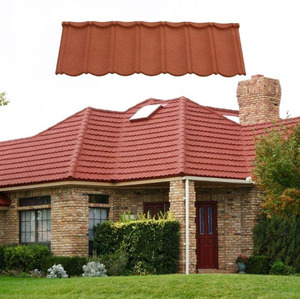
Combines the tensile strength of 55% Al-Zn steel with acoustic-dampening stone granules. Delivers Class A fire protection and complete resistance to freeze-thaw spalling.
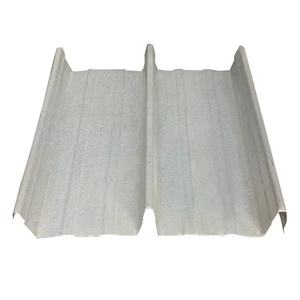
High-strength trapezoidal profile engineered to span structural cold-formed purlins, accommodating extreme Ontario snow load accumulations ($S_s + S_r$).
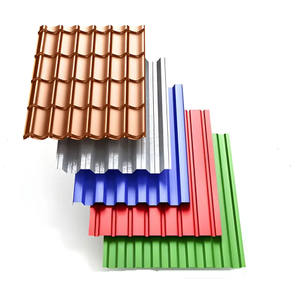
Bulk commercial panels for general construction, agricultural envelopes, and industrial storage. Mill-tested chemical certs supplied with containerized ocean freight.
The Greater Toronto Area (GTA) and the Golden Horseshoe present one of North America's most demanding climatic testing grounds for external building envelopes. Situated on the northwestern shore of Lake Ontario, Toronto experiences an aggressive combination of high-humidity summer heat waves with temperatures exceeding +35°C, followed by severe continental sub-zero winter fronts dropping below -25°C. This swings the envelope through more than 60 thermal freeze-thaw cycles annually, placing intense shearing forces on mechanical fastenings, seams, and metal crystalline structures.
Traditional roofing systems, including asphaltic architectural shingles and built-up organic felts, deteriorate rapidly under this continuous thermal cycling. Bituminous binders oxidize, micro-fissure under solar ultraviolet radiation, and absorb moisture during late-autumn rain events. When this retained moisture freezes, hydraulic expansion causes delamination, gravel loss, and premature membrane failure within 12 to 15 years. In sharp contrast, architectural rolled zinc (conforming to ASTM B69) and continuous hot-dip 55% aluminum-zinc alloy-coated steel (Galvalume / Aluzinc conforming to ASTM A792 / A792M) establish a thermodynamic equilibrium with the Ontario environment.
Self-Healing Passivation Mechanism: When exposed to ambient moisture ($H_2O$) and carbon dioxide ($CO_2$) in Toronto's troposphere, architectural zinc reacts sequentially to develop zinc hydroxyl carbonate ($2ZnCO_3 \cdot 3Zn(OH)_2$). This microcrystalline, insoluble patina self-seals minor scratches, resists atmospheric airborne chlorides, and prevents continuous oxidative degradation.
Roofing specifications in Toronto must strictly adhere to the structural provisions set forth in Section 4.1.6 (Snow Loads) and Section 9.26 (Roofing) of the Ontario Building Code. Structural design in Toronto demands factoring a specified ground snow load ($S_s$) of 1.4 kPa to 1.6 kPa, combined with an associated rain load ($S_r$) of 0.4 kPa. When calculating specified roof snow loads using the governing formula:
S = I_s \cdot [S_s \cdot (C_b \cdot C_w \cdot C_s \cdot C_a) + S_r]
Where drift accumulation ($C_a$) occurs against high parapets, mechanical penthouses, or multi-level stepped roofs (common across Toronto commercial developments), local design loads frequently surge beyond 3.8 kPa. To prevent deflection and buckling, zinc roofing sheets must feature tailored section moduli ($Z_x$), precise panel widths (commonly 300 mm to 430 mm), and engineered gauge thickness (0.7 mm to 0.8 mm for pure zinc; 24 to 22 gauge for 55% Al-Zn steel). Continuous support cleats with allowance for longitudinal thermal expansion ($22 \times 10^{-6}\text{ m/m}\cdot\text{K}$) are vital to prevent panel oil canning and clip shear failure.
Evaluate structural zinc, 55% Al-Zn alloy, and conventional galvanized cladding across essential physical parameters.
| Material System | Standard & Alloy Grade | Yield Strength (MPa) | Corrosion Mechanism | Thermal Expansion | Toronto Green Standard SRI | Service Life |
|---|---|---|---|---|---|---|
| Architectural Rolled Zinc | ASTM B69 Type 1 (99.9% Zn + Ti-Cu) | 150 - 180 MPa | Self-healing hydroxyl carbonate patina | 22 × 10⁻⁶ m/m·K | Tier 2 Ready (SRI 82) | 80 - 100+ Years |
| 55% Al-Zn (Galvalume) | ASTM A792 / AZ150 / AZ180 | 345 - 550 MPa (G345/G550) | Barrier Al network + Sacrificial Zn cut-edge | 12 × 10⁻⁶ m/m·K | Tier 1 Ready (SRI 78) | 40 - 60 Years |
| Heavy Galvanized PPGI | ASTM A653 / Z275 + SMP Topcoat | 250 - 350 MPa | Sacrificial Zn layer beneath polymer seal | 12 × 10⁻⁶ m/m·K | Color Dependent | 25 - 35 Years |
| Standard Commercial G90 | ASTM A653 / Z180 - Z275 | 230 - 280 MPa | Standard galvanic protection (rapid white rust) | 12 × 10⁻⁶ m/m·K | Low (Raw Finish) | 15 - 20 Years |
Engineered installations solving exact structural and aesthetic challenges in commercial, civic, and residential envelopes.
Extensive warehousing complexes across Peel Region, Vaughan, and Milton require long-span low-slope envelopes that minimize dead-load while bearing dynamic drifting snow.
Custom architectural residences in Yorkville, Forest Hill, Rosedale, and The Beaches demand striking matte finishes that age with grace while resisting coastal lake squalls.
Facilities adjacent to the Gardiner Expressway, Lake Shore Boulevard, and Metrolinx corridors face high airborne road-salt sprays and aggressive exhaust residues.
The City of Toronto's Green Standard (TGS) Version 4 sets stringent benchmarks for carbon reduction, stormwater runoff, and heat island mitigation. For building permits across the city, roof surfaces must achieve specific Solar Reflectance Index (SRI) values: an SRI of at least 78 for low-slope roofs (slopes ≤ 2:12), and an SRI of at least 29 for steep-slope roofs (slopes > 2:12). Premium pre-weathered zinc and specialized cool-pigmented Galvalume profiles effortlessly exceed these metrics, dramatically reducing the urban heat island effect across densely populated downtown corridors.
Furthermore, structural zinc contributes significantly to Life Cycle Assessment (LCA) points under LEED v4.1 and zero-carbon building frameworks. Rolled architectural zinc requires significantly lower embodied energy during smelting and refining compared to primary architectural aluminum or stainless steel. When combined with a 100% end-of-life recyclability rating and non-toxic runoff compliance under Toronto and Region Conservation Authority (TRCA) guidelines, zinc stands out as the premier structural substrate for sustainable architecture.
Acoustic & Ice-Dam Engineering: In freeze-thaw climates like Southern Ontario, roofers must install high-temperature self-adhering elastomeric modified bitumen underlayments directly over tongue-and-groove or OSB sheathing beneath zinc sheets. This prevents condensation traps and isolates the metal panels from galvanic interactions with alkaline structural substrates.
With Ontario's push toward commercial building electrification, commercial standing seam zinc and Galvalume roofs serve as ideal substrates for non-penetrating solar clamp fixtures (such as engineered S-5! clamps). Because standing seams protrude 25 mm to 38 mm above the pan, solar mounting racking locks directly onto the seam rib without penetrating the moisture barrier. In addition, engineered snow retention pipes are mounted in the same clamp manner to prevent dangerous sudden winter snow slides onto pedestrian thoroughfares.
Combining heavy-industry manufacturing capacity with precise international freight routing straight to Southern Ontario yards.
Operating high-speed continuous roll-forming lines with multi-point optical profiling sensors. We control tolerances down to ±0.5 mm on profile depth, flange symmetry, and diagonal squareness.
Direct freight routing to the Port of Montreal, Port of Hamilton, and Toronto CN/CP intermodal rail yards. Containerized crating utilizes heavy fumigated timber skids and vapor-corrosion-inhibitor (VCI) moisture barriers.
Direct technical answers addressing Ontario Building Code compliance, structural snow loads, galvanic corrosion, and shipping.
Consult with our structural envelope specialists to review architectural CAD drawings, specify ASTM/OBC compliance, and secure factory-direct pricing for your next Ontario project.
Our sales engineers respond to project questions during working hours (GST+4).