
Engineered Galvanized C & Z Steel Purlins
Purlins are cold-formed structural members designed to support roofing sheets, insulated sandwich panels, and wall cladding while transferring wind and gravity loads directly to primary portal frames. Manufactured in Muscat, Oman, on high-speed continuous roll-forming lines, Emaar Industries provides precision-profiled C and Z sections configured to the exact engineering calculations of your pre-engineered steel project.
C Purlin vs. Z Purlin: Engineering Comparison
Choosing between C and Z profiles is determined by building spans, support conditions, and moment distribution. Explore their structural characteristics and optimal application zones below.
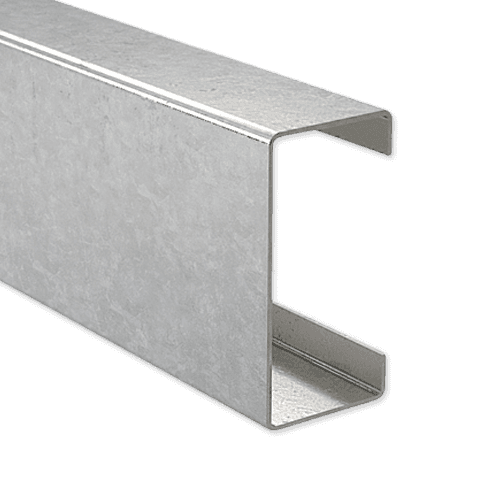
C-Section Purlins
C purlins feature equal flanges and a stable geometry that requires no continuous lapping. They are predominantly utilized as single-span framing members, wall girts, eaves struts, door jambs, window headers, and light floor joists. Their flat back permits simple, secure mechanical fastening against structural columns and rafters.
- Simply Supported Spans: Exceptional stability over individual bays without complex overlapping.
- Wall Girt Integration: Flush face alignment simplifies side-wall sheeting and insulated sandwich panel installation.
- Direct Cleat Bolting: Pre-punched standard gauge web holes match standard structural rafter cleats.
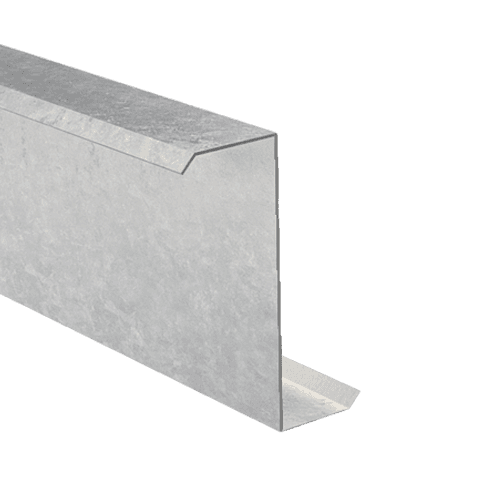
Z-Section Purlins
Z purlins are engineered with unequal, subtly inclined flanges that rotate 180 degrees to nest cleanly inside one another. This unique nesting geometry allows Z purlins to be overlapped over intermediate supports, transforming single spans into continuous multi-bay structural beams that reduce bending moments by up to 20%.
- Continuous Lapped Capacity: Moment redistribution over rafter supports reduces mid-span deflection and allows lighter gauges.
- Roof Framing Optimization: Primary choice for medium-to-large bay warehouses, logistics hubs, and factories.
- Compact Logistics Bundling: High-density nesting cuts sea freight volume and overland trailer space significantly.
Comprehensive Selection Matrix
Review the structural and practical distinctions between C and Z profiles to ensure your project's bills of quantities (BOQ) match real-world erection requirements.
| Design Factor | C Purlin Section | Z Purlin Section | Engineering Advantage |
|---|---|---|---|
| Cross-Section Profile | Channel with symmetrical top and bottom flanges (C-shape) | Zeta shape with unequal flanges for nested lapping (Z-shape) | Z allows seamless 180° inversion for nested connections |
| Structural Spanning System | Single-span (simply supported between rafter portals) | Continuous multi-span (lapped over intermediate frames) | Z reduces positive mid-span bending moments by ~20% |
| Splicing & Lapping Ability | Butt-jointed or spliced with external channel sleeves | Direct overlapping over support cleats without extra sleeves | Eliminates sleeve accessories and speeds crane erection |
| Primary Application Zones | Wall girts, fascia supports, door frames, eaves framing | Main roof purlins for multi-bay PEB buildings & hangars | Provides optimal stiffness for long roof slopes and paneling |
| Steel Weight Efficiency | Standard weight determined by individual bay span | Lower steel tonnage per square meter over multi-span bays | Reduces overall secondary structural tonnage and project cost |
| Stacking & Transport | Side-by-side or interlocking block stacking | Fully nested stacked bundles requiring minimal bundle height | Lowers shipping volume for GCC & African export containers |
Standard Dimensions & Section Properties
Every purlin is roll-formed from certified prime steel coil. Below are our most widely specified section profiles. Custom web depths, flange dimensions, and thickness gauges are manufactured upon review of your structural drawings.
| Profile Designation | Depth H (mm) | Flange B (mm) | Lip C (mm) | Thickness Range (mm) | Standard Yield Strength |
|---|---|---|---|---|---|
| C / Z 100 Series | 100 mm | 45 / 50 mm | 15 mm | 1.5 mm – 2.0 mm | 345 MPa / 450 MPa |
| C / Z 150 Series | 150 mm | 50 / 65 mm | 18 mm | 1.5 mm – 2.5 mm | 345 MPa / 450 MPa |
| C / Z 200 Series | 200 mm | 60 / 70 mm | 20 mm | 1.8 mm – 3.0 mm | 345 MPa / 450 MPa |
| C / Z 250 Series | 250 mm | 65 / 75 mm | 20 mm | 2.0 mm – 3.2 mm | 345 MPa / 450 MPa |
| C / Z 300 Series | 300 mm | 75 / 85 mm | 22 mm | 2.0 mm – 3.2 mm | 345 MPa / 450 MPa |
| C / Z 350 Series | 350 mm | 85 / 95 mm | 25 mm | 2.5 mm – 3.2 mm | 345 MPa / 450 MPa |
Built for Demanding Climates & Tolerances
Secondary structural members must withstand dead load, live load, wind suction, and high environmental corrosion without lateral-torsional buckling or premature oxidation.
Certified Structural Steels
Roll-formed from certified prime hot-dip galvanized and Aluzinc coils with guaranteed yield strengths of 345 MPa to 450 MPa. Every batch is certified with complete 3.1 Mill Test Certificates (MTC).
Automated CNC Punching
Integrated hydraulic punches produce slotted (14×22 mm / 18×22 mm) and round (14 mm / 18 mm) holes at exact pitch centers during profiling, preventing thermal stress distortion and ensuring bolt-hole precision.
Marine & Desert Resistance
Zinc coating options up to Z275 (275 g/m²) and AZ150 Aluzinc resist the severe atmospheric corrosion common to coastal ports, humidity, and chemical vapor exposures across the Arabian Gulf.
Strict Geometric Straightness
Computerized multi-station cold rolling maintains tight camber, bow, and twist limits in compliance with BS 5950 Part 5 and ASTM A1003, ensuring level purlin planes for roof sheets and solar brackets.
Complete Building Envelopes
Procure your entire roofing and wall envelope from a single source: purlins, composite metal decking, single-skin profile sheets, insulated sandwich panels, and colour-matched flashing trims.
Export Packing & Dispatch
Custom piece-marked bundles organized by portal bay and erection sequence. Transported overland across Oman, UAE, Saudi Arabia, Qatar, or containerized for East African seaports.
Expert Answers for Structural Engineers
Key technical considerations regarding section sizing, continuous lapping, hole spacing, and coating selection for industrial buildings.
The primary difference is the cross-sectional geometry and resulting connection method. C purlins feature symmetrical channel flanges and are typically specified for simply supported single spans, perimeter wall girts, and headers. Z purlins have unequal flanges that allow them to be inverted 180 degrees and nested inside one another over portal rafter cleats. This creates continuous beam structural action, reducing deflection and steel weight across multi-bay building layouts.
When Z purlins are overlapped across intermediate supports (with typical lap lengths between 600 mm and 1200 mm based on structural calculations), the double-thickness nested zone provides significant negative moment capacity over the rafters. This redistributes structural stress, lowers peak mid-span bending moments, and allows engineers to either use lighter steel gauges or widen portal frame bay spacing without exceeding deflection limits.
Our purlins are cold-formed from high-yield structural steel coils conforming to ASTM A653 / A653M (Grade 50, minimum yield strength 345 MPa) and EN 10346 (S350GD, S390GD, or S450GD). Available zinc coatings range from Z120 up to heavy commercial Z275 (275 g/m² total both sides). For coastal or marine industrial facilities subject to high humidity and salinity, AZ150 Aluzinc / Galvalume is recommended for enhanced barrier durability.
Yes. Our automated roll-forming lines feature integrated hydraulic CNC punch presses. We provide standard round holes (14 mm and 18 mm diameter) for cleat fastening and elongation slots (14×22 mm and 18×22 mm) to accommodate erection tolerances and thermal expansion. Hole centers and gauge lines are programmed directly from customer structural drawings.
Emaar Industries produces C and Z profiles in web depths from 100 mm to 350 mm, with steel thickness ranging between 1.5 mm and 3.2 mm. Purlins can be precision cut-to-length up to 14 meters. Maximum piece lengths are typically governed by site access, overland flatbed regulations, or 40-foot shipping container limits for export projects.
For perimeter wall cladding systems, C purlins are frequently favored because their flat web face rests flush against portal columns, simplifying corner trims, window openings, and wall panel fixings. However, for extremely high bay walls subject to high wind suction pressures, continuous lapped Z girts can also be engineered to improve resistance to lateral deflection.
Engineered Purlin Schedules for Your Steel Structures
Send your project bay spacing, wind load requirements, and structural framing plans. Our engineering team will supply load-span capacity tables, optimized cutting lists, and competitive direct-from-mill pricing.
Get Catalog